Located in Fukuoka City, Hakata Station is Kyushu’s principal rail hub and one of the most important railway gateways in southern Japan. It is the western terminus of the Sanyo Shinkansen from Shin-Osaka, with direct Tokaido-Sanyo Shinkansen services linking Hakata with Tokyo, Kyoto, Osaka and Hiroshima. It also connects with the Kyushu Shinkansen for Kumamoto and Kagoshima-Chuo.
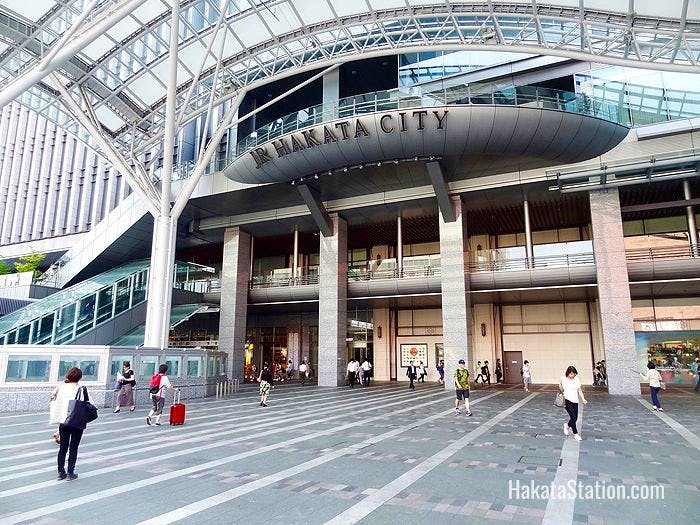
The west side of Hakata Station features the entrance to the Hakata City commercial complex
Hakata Station has grown in importance as a rail hub since 2011, when through Sanyo-Kyushu Shinkansen services from Shin-Osaka to Kagoshima-Chuo began, linking the two cities in just under four hours.
The station is served by several operators: JR Kyushu handles the conventional JR lines and Kyushu Shinkansen services, JR West handles Sanyo Shinkansen and Hakata-Minami Line services, and the Fukuoka City Transportation Bureau operates the subway station.
As part of the large JR Hakata City commercial complex, Hakata rivals some of the big rail hubs in Tokyo. It also serves as a convenient jumping-off point to explore Fukuoka City, Fukuoka Prefecture and points further south in Kyushu.
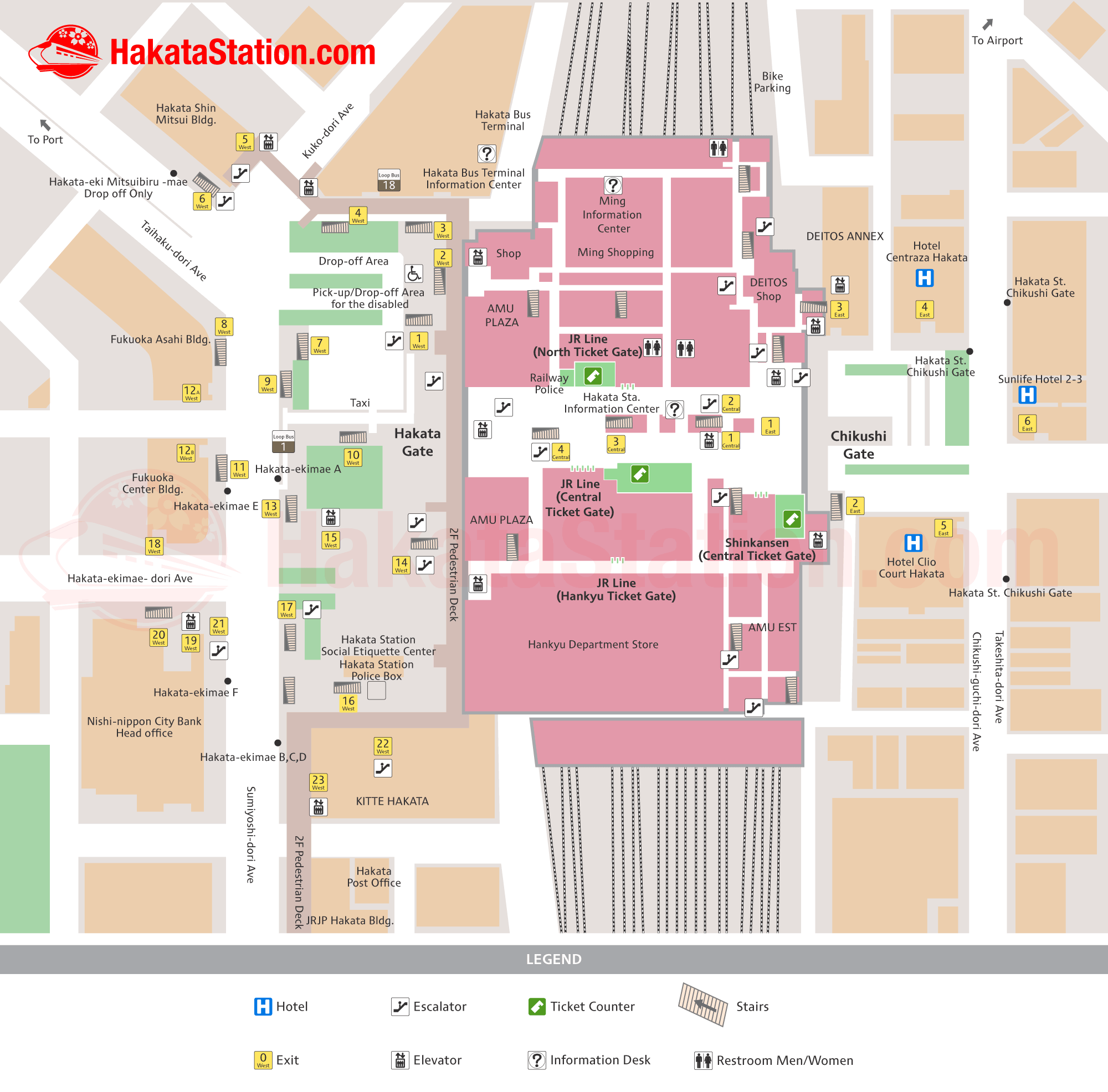
This article will familiarize you with the layout of Hakata Station and its train lines, gates and platforms. For information about non-rail services, see our Hakata Station Building Facilities article.
General Orientation
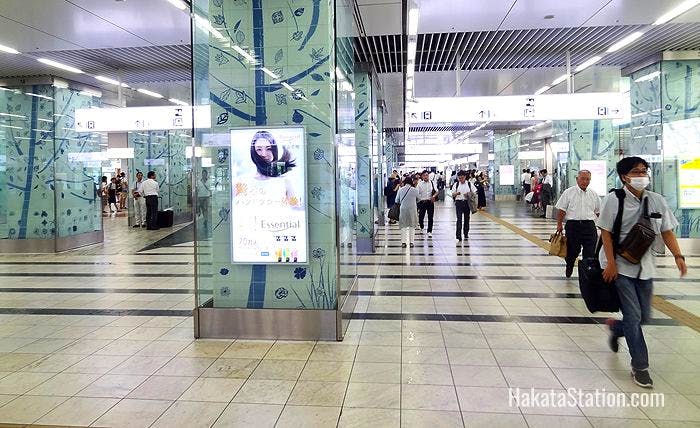
A broad tiled corridor runs through the main part of Hakata Station
Hakata Station is situated in Hakata-ku, one of the central wards of Fukuoka City. It is about 2 km east of the downtown Tenjin district, home to Nishitetsu-Fukuoka Station, and about 2.75 km west of Fukuoka Airport. Both Tenjin and the airport can be reached quickly by subway.
Hakata now has two Fukuoka City Subway lines. The Airport Line is the line to use for Fukuoka Airport, Gion, Nakasu-Kawabata, Tenjin, Meinohama and through services toward the Chikuhi Line. The Nanakuma Line was extended to Hakata in 2023 and is the line to use for Kushida Shrine, Tenjin-minami and Hashimoto.
The Nanakuma Line platforms are deeper and farther from the Shinkansen area than the Airport Line platforms, so allow more time when transferring with luggage. JR West’s current station map gives standard Shinkansen transfer allowances of about 10 minutes for the Airport Line and about 15 minutes for the Nanakuma Line.
The JR railway lines at Hakata Station are oriented north-south, while the Airport Line crosses the station roughly east-west and the Nanakuma Line approaches beneath the west side of the complex. The major entrances for Hakata Station are on its eastern and western sides.
The Airport Line can be accessed via entrances on both sides of Hakata Station. For the Nanakuma Line, follow the signs for the subway and allow extra time if you are coming from the Shinkansen gates on the Chikushi side.
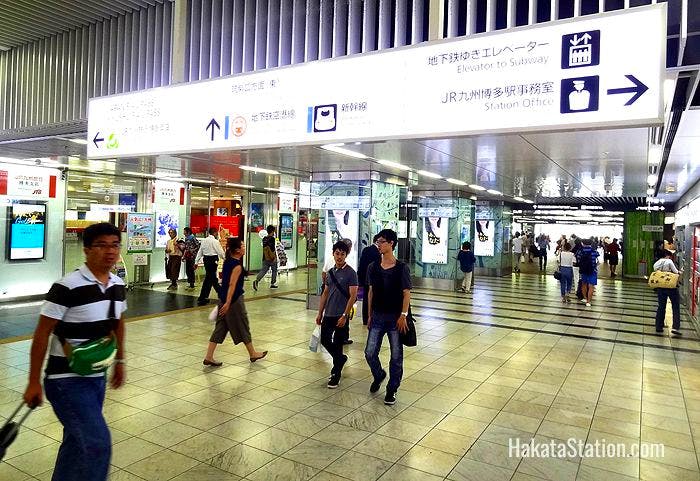
Overhead signs point the way for passengers at Hakata Station
The ground-level layout is straightforward, with a broad corridor connecting the two sides of the station. The full station complex is more layered than it first appears, however, because the conventional JR lines, Shinkansen concourse, Airport Line and Nanakuma Line occupy different areas and levels. The safest approach is to confirm your line first, then follow the overhead signs for the correct gate or subway entrance.
The buildings surrounding the station include shopping malls and department stores, as well as hotels, dining and leisure facilities. On the west, or Hakata, side of the station you will find Hakata Hankyu, AMU Plaza Hakata, HANDS and KITTE Hakata. On the east, or Chikushi, side are AMU EST, Hakata Deitos and Yodobashi Camera Multimedia Hakata. There are three underground shopping areas at Hakata Station: Ming, Hakataeki Chikagai and Hakata Ichibangai. City Dining Kooten is the restaurant zone on the ninth and tenth floors of JR Hakata City.
Hakata Station Main Gates and Exits
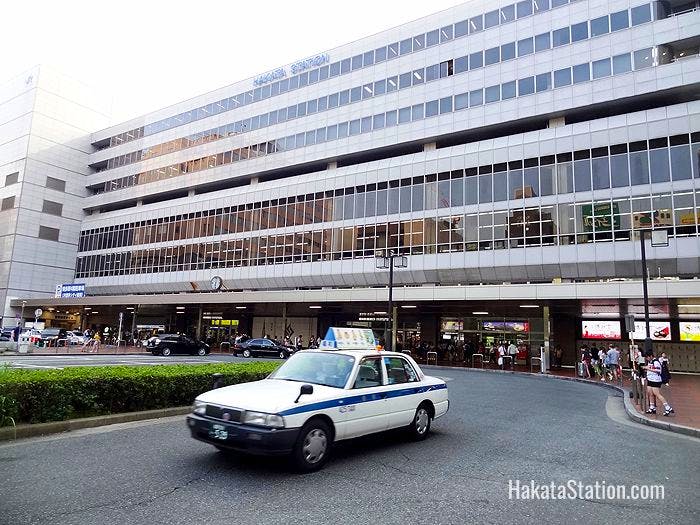
Chikushi side of Hakata Station is more subdued than the Hakata side
The west side of Hakata Station faces toward the Nakasu nightlife district as well as the Tenjin area and is known as the Hakata Entrance, or Hakata side. It has a grand facade, and the Hakata Bus Terminal is located off its northern end.
The east side, known as the Chikushi Entrance, or Chikushi side, is more subdued, but it has the closest access to the main Shinkansen concourse and gates.
It is useful to distinguish station entrances from ticket gates. The Hakata and Chikushi entrances describe the public sides of the station building. Ticket gates are the points where you enter the paid JR or Shinkansen areas.
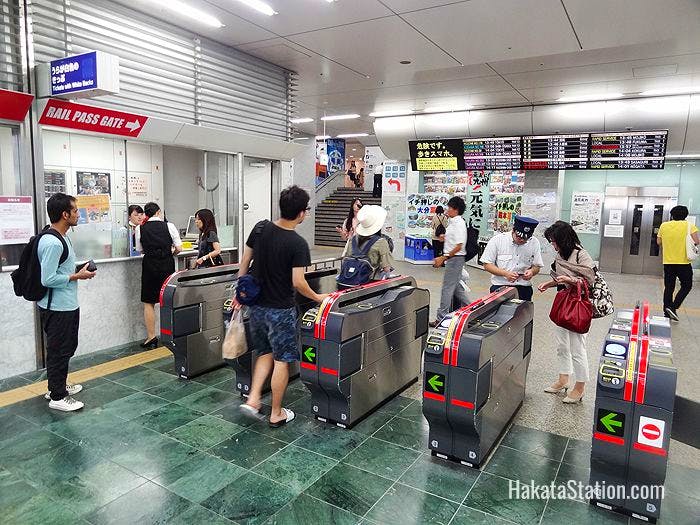
The Central Gate at Hakata Station
For the conventional JR platforms, the main gates include the Central Gate, North Gate and Hakata Gate. Access to the JR platforms is also possible through smaller retail-linked gates attached to surrounding areas such as the HANDS Gate, Amu Plaza Gate, Ming Gate and Hankyu Gate, though some of these gates may have limited hours or IC-card restrictions.
For Shinkansen services, use the Shinkansen Central Gate or the Hikari Plaza Gate when entering from outside the paid area. If you are transferring between conventional JR lines and the Shinkansen, use the Shinkansen Central Transfer Gate or the North Transfer Gate. Because Hakata has several operators and multiple concourses, always follow the current overhead signs for your train name, destination and gate.
JR Train Line Platforms
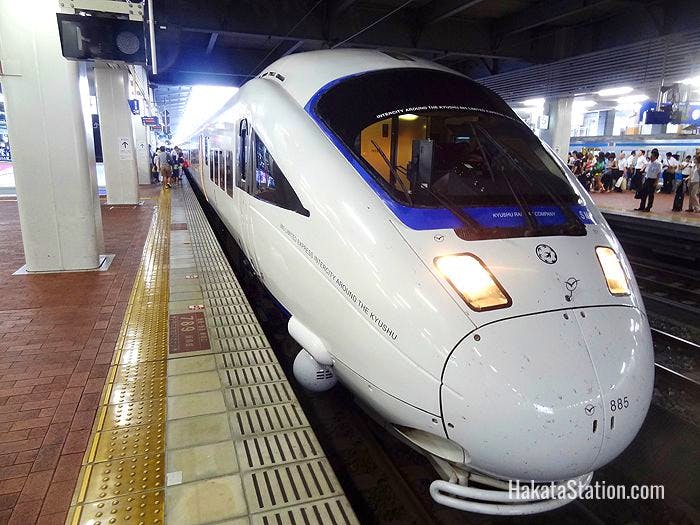
An 885 Series limited express at Hakata Station
There are 14 numbered JR platform tracks at Hakata Station. Platforms 1 to 8 are used for conventional JR services, while platforms 11 to 16 are used for Shinkansen and Hakata-Minami Line services. Some services use multiple platforms even for trains traveling in the same direction, so treat the list below as normal guidance and always check your ticket and the departure boards before boarding.
The Hakata-Minami Line runs without intermediate stops from Hakata to Hakata-Minami, a commuter station beside a rail yard in Fukuoka. It uses Shinkansen-style trains and Shinkansen platforms, but it is operated by JR West as a conventional line.
Platform 1: Kagoshima Main Line bound for Kashii, Kurosaki and Kokura
Platform 2: Kagoshima Main Line bound for Kurosaki, Kokura and Mojiko; Nippo Main Line limited express services bound for Oita, Saiki and Miyazaki
Platform 3: Kagoshima Main Line bound for Kurosaki, Kokura and Mojiko; limited express services toward the Nagasaki and Sasebo directions, including Relay Kamome services to Takeo-Onsen for the Nishi Kyushu Shinkansen connection to Nagasaki
Platform 4: Kagoshima Main Line bound for Kurosaki and Kokura; limited express services including Relay Kamome for Takeo-Onsen, Midori for Sasebo and Huis Ten Bosch services for Huis Ten Bosch
Platform 5: Kyudai Main Line limited express services bound for Yufuin and Oita; Kagoshima Main Line bound for Tosu, Kurume, Omuta and Arao
Platform 6: Kagoshima Main Line bound for Tosu, Kurume, Omuta and Arao
Platform 7: Sasaguri Line bound for Nogata; Kagoshima Main Line bound for Tosu, Kurume, Omuta and Arao
Platform 8: Sasaguri Line bound for Sasaguri, Shin-Iizuka and Nogata
Sanyo, Tokaido and Kyushu Shinkansen Bullet Train Platforms
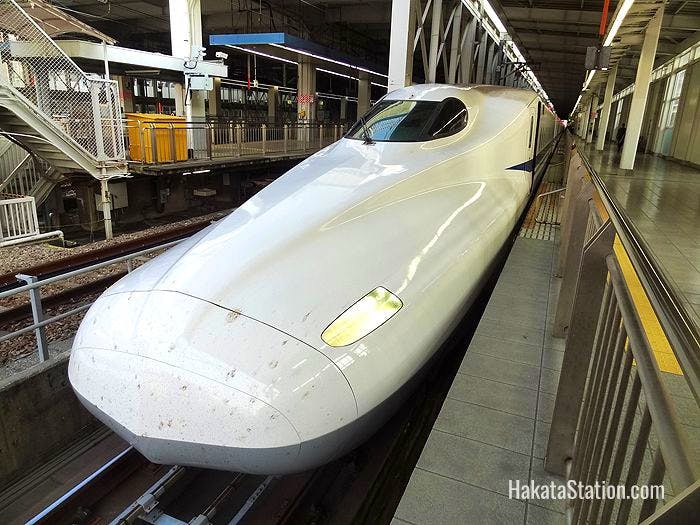
An N700 Series Shinkansen bound for Tokyo set for departure from Hakata Station
The Shinkansen platforms at Hakata Station are used by Kyushu Shinkansen trains to Kumamoto and Kagoshima-Chuo, Sanyo and Tokaido Shinkansen services toward Hiroshima, Shin-Osaka, Kyoto, Nagoya and Tokyo, and Hakata-Minami Line services to Hakata-Minami. Platform assignments can vary by train, so check the departure board and your ticket before heading to the platform.
Platform 11: Kyushu Shinkansen bound for Kumamoto and Kagoshima-Chuo; Hakata-Minami Line bound for Hakata-Minami
Platforms 12 to 16: Kyushu Shinkansen bound for Kumamoto and Kagoshima-Chuo; Sanyo and Tokaido Shinkansen services bound for Hiroshima, Shin-Osaka, Kyoto, Nagoya and Tokyo; Hakata-Minami Line services bound for Hakata-Minami, depending on the train
Article by Tim Hornyak. All rights reserved. Last updated 20-Jul-2026.