Fukuoka City has a small but handy subway system. For travelers, the most useful of the three lines is the Airport Line, also known as the Kuko Line, which goes to Fukuoka Airport, Hakata Station and the Tenjin downtown area.
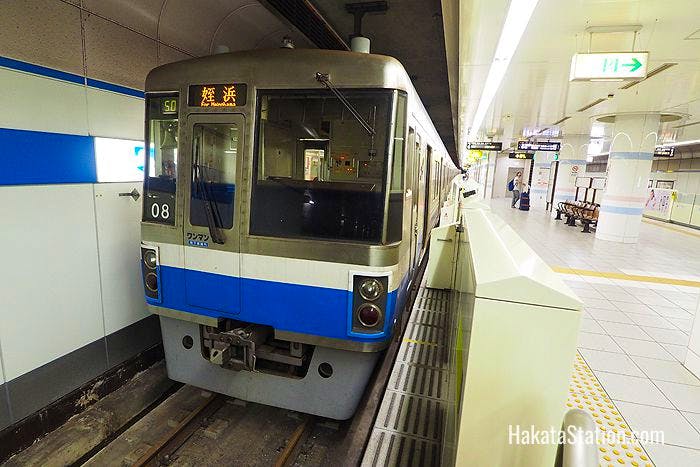
A subway train bound for Meinohama stops at Fukuoka Airport Station on the Fukuoka City Subway Airport Line
Hakata Station, the main rail hub for the city, is on the Airport Line and only two stops from Fukuoka Airport. The line also runs westward through Nakasu-Kawabata, Tenjin and Meinohama. At the airport, Fukuoka-kuko Station is directly connected to the Domestic Terminal. If you are using the International Terminal, take the free shuttle bus between the terminal buildings.
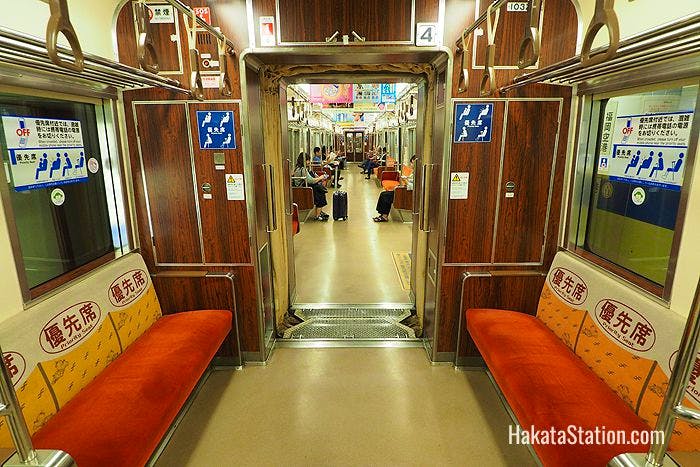
Inside a car on the Fukuoka City Subway Airport Line
The other two lines in the Fukuoka subway system are the Hakozaki Line, which goes from Nakasu-Kawabata to Kaizuka, and the Nanakuma Line, which goes from Hashimoto to Hakata.
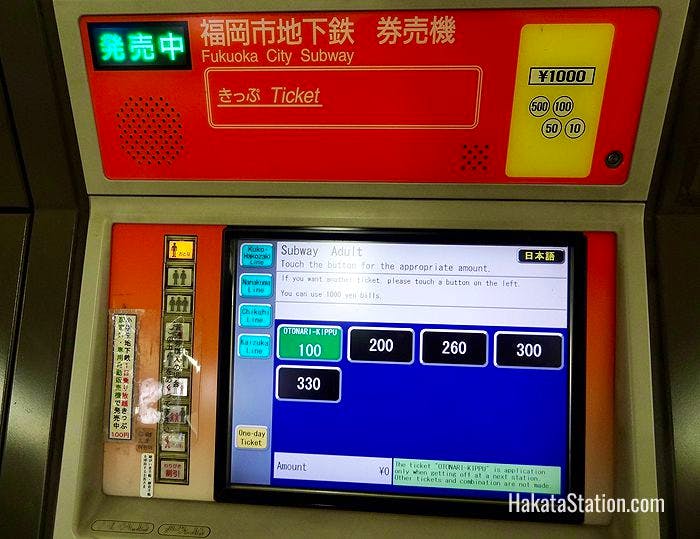
A ticket vending machine for the Fukuoka subway
Riding on the subway is straightforward. Check the required fare on the fare chart next to the ticket vending machines, press “English” on the vending machine display, and buy the right paper ticket. You can also use HAYAKAKEN stored-value cards, as well as major IC cards such as Suica, PASMO, ICOCA, SUGOCA and nimoca.
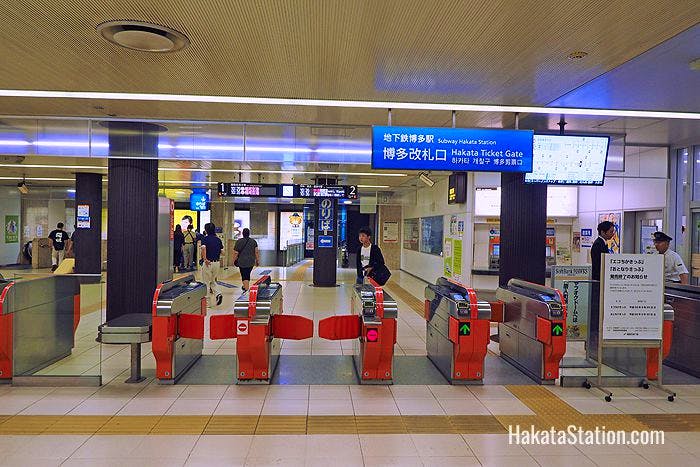
Ticket gates at Hakata on the Fukuoka subway
Adult subway fares are based on distance and range from 210 yen to 380 yen. Child and discounted fares are lower. One-day passes allowing unlimited travel on all Fukuoka City Subway lines are 640 yen for adults and 320 yen for children or discounted-fare users. HAYAKAKEN users can also earn one-station points on short subway rides.
Subway trains generally start around 5:30 am, run frequently during the day, and continue until after midnight. Check the current timetable if you need the first or last train.
Key Destinations
Fukuokakuko (Fukuoka Airport)
Fukuoka’s busy airport, which serves as a gateway to the whole Kyushu region of Japan, is conveniently located only a few kilometers from Hakata Station. Fukuoka Airport Station is two stops from Hakata on the subway and connects directly with the Domestic Terminal. For the International Terminal, transfer by free shuttle bus between the domestic and international terminal buildings.
Train fare: 260 yen
Train time: about 5 minutes
Nakasu-Kawabata
Get off here for the Nakasu nightlife district, which takes up a large chunk of Nakasu Island in the Naka River. Nakasu is one of Fukuoka’s best-known dining and nightlife areas, with restaurants, bars, yatai food stalls, and the headquarters of the Ichiran ramen chain. Across from the southeast side of Nakasu you will find Canal City Hakata, a large shopping and entertainment complex with hotels, a theater, a cinema, shops and restaurants.
Train fare: 210 yen
Train time: 3 minutes
Tenjin
Tenjin is one of Fukuoka City’s busiest downtown districts. It is known for Tenjin Chikagai, Kyushu’s largest underground shopping area, with about 150 shops spread over roughly 590 meters. Above ground, the district has department stores and malls clustered around the station area, including ONE FUKUOKA BLDG. Other local attractions include ACROS Fukuoka, a must-see for architecture buffs with its terraced, forested facade, Kihinkan Hall, built in 1910, and the Fukuoka Akarenga Cultural Center, an example of 19th-century British-style architecture completed in 1909.
Tenjin Station is not to be confused with Nishitetsu Fukuoka (Tenjin) Station, part of a railway operated by Nishi-Nippon Railroad (Nishitetsu). The railway here, the Nishitetsu Tenjin Omuta Line, connects Fukuoka with Omuta, Fukuoka Prefecture. It can be used to reach Dazaifu, through a transfer at Nishitetsu Futsukaichi, home to the famous Tenmangu Shrine, as well as Yanagawa, renowned for its network of old-world canals.
Train fare: 210 yen
Train time: about 5 minutes
Article by Tim Hornyak. All rights reserved. Last updated 26-Jul-2026.